


Table of Contents
INTRODUCTION
For many commercial fleets, driver and public safety is a top priority, and organizations take great care to prevent costly and potentially deadly accidents. While a number of factors can lead to a crash (e.g., impaired driving, poor road conditions and adverse weather), distracted driving is a common, preventable cause of accidents. Data from the National Highway Traffic Safety Administration (NHTSA) indicates that every year, up to 391,000 people are injured and 3,450 people are killed in crashes involving distracted drivers.
The NHTSA defines distracted driving as any activity that diverts attention from driving.
Distracted driving reduces awareness, decision-making and performance, increasing the likelihood of driver error, near-crashes or crashes. What’s more, distracted driving is not always attributable to a medical condition, alcohol and drug use, or fatigue.
Distracted driving is an ongoing safety concern for commercial fleets. However, the widespread increase in cellphone use over the past decade has brought the issue to the forefront.
Studies have shown that many collisions and near-collisions involve some form of driver inattention, often just three seconds prior to the event. These statistics are particularly noteworthy for fleets, as many commercial vehicles have poorer driver visibility than personal cars and are much more difficult to control or stop in the event of an emergency. For commercial fleets, distracted driving can lead to increased insurance premiums, costly repairs, decreased productivity, reputational damage, and driver injury or death.
To protect themselves and public safety, it’s important for organizations and fleet managers to have an understanding of distracted driving, including common causes and prevention strategies. This guide provides background information commercial fleets can use to supplement a risk management program and establish a safe workplace.
TYPES OF DISTRACTED DRIVING
Often, when thinking about distracted driving, it’s easy to focus on inattentiveness caused by cellphones and other electronic devices. However, while texting and taking phone calls while driving are major causes of accidents, they aren’t the only distractions.

Any time a driver reaches for an object or gets distracted by outside stimuli, the chances of an accident drastically increase. In fact, studies show that simply by dialing a cellphone, the likelihood of a crash is six times greater.
To remain safe on the roads, drivers need to be aware of common distractions that can put them and the public in danger:
- Using electronic devices such as a GPS, MP3 player, radio, cellphone or laptop
- Reading maps, books, texts or printed directions
- Combing hair, putting on makeup, shaving, brushing teeth or performing similar grooming activities
- Eating, drinking or smoking
- Talking with passengers or tending to children or pets
- Focusing attention on visual distractions outside the vehicle, such as collisions, police activity, street signs, pedestrians, construction or billboards
- Multitasking
- Daydreaming
Distracted Driving Laws
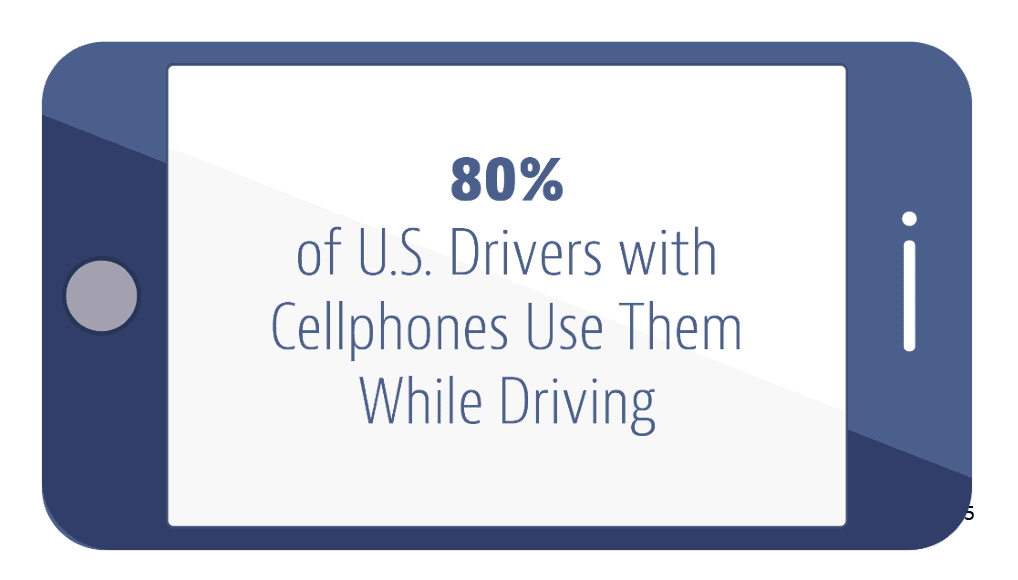
Not only can distracted driving lead to increased exposures and expenses for your firm, but it can also result in major fines and penalties. Distracted driving is not just a concern for commercial fleets. In fact, the National Conference of State Legislatures estimates that 80% of U.S. drivers with cellphones use them while driving. What’s more, the NHTSA estimates that 481,000 passenger vehicles throughout the Unites States are driven while using hand-held devices on a daily basis.
Several states and the District of Columbia have banned hand-held phone use by all drivers as of late 2018, including California, Connecticut, Delaware, Georgia, Hawaii, Illinois, Maryland, Nevada, New Hampshire, New Jersey, New York, Oregon, Rhode Island, Vermont, Washington and West Virginia. Legislatures in other states have prohibited cellphone use by younger drivers or school bus drivers.
Distractions can come from a variety of sources and affect your drivers at any time. While accidents aren’t always preventable, fleet managers can reduce the risk by creating and implementing procedures that limit distracted driving.
RESPONDING TO DISTRACTED DRIVING
Even the most experienced drivers can become distracted from time to time. In order to maintain safe driving practices, organizations must take a top-down approach to combating distracted driving. Only through effective policies and training can commercial fleets identify and respond to potentially harmful driving behaviors.
Tips for Employers
The following are some ways organizations and their fleet managers can help reduce the risk of distracted driving:
- Create a driver safety program and a distracted driving policy. Regularly communicate your policies using things like emails, blogs and posters.
- Use applications to detect when your drivers are on the road. Many of these applications prevent individuals from contacting a driver while their vehicle is in motion.
- Instruct drivers to pull off the road and park if they need to use their phone or an electronic device.
- Equip vehicles with lockboxes that drivers can use to store potential distractions, like smartphones and tablets.
- Educate your drivers on the risks of driving while distracted. Use real-life examples and stories to explain how dangerous distracted driving can be.
- Update your organization’s handbook, noting any disciplinary actions you will take if you identify unsafe driving behavior.
- Ask your employees to sign a pledge form indicating their willingness to drive in a safe and courteous manner.
- Work with drivers to plan trips. This ensures that drivers have a clear understanding of their routes, which can reduce the need for GPS and other potentially distracting navigation devices.
- Manage driver schedules to ensure employees are well-rested between trips.
- Use telematics, driver monitoring programs and in-cabin camera systems to evaluate individual drivers. Whenever possible, reward positive driver behavior to encourage a culture of safety.
- Perform a safety audit, which will give you a high-level overview of distracted driving risks and other concerns.
Technology to Monitor and Assist Drivers
New technology can alert employers about potential distracted driving situations. Electronic logging devices use hours of service data to monitor how long truck drivers spend behind the wheel and the length of their rest periods. Additional software can monitor drivers using in-vehicle cameras and send signals when their heads nod or their eyes wander. There are also smartphone applications that shut off distractions when vehicles are moving.
Automated Vehicles
In an effort to save lives and prevent injuries caused by distracted driving and human error, automated technology continues to evolve. Advanced driver assistance systems (ADAS) warn drivers of safety risks, and automated driving systems (ADS) take control of certain driving tasks. Ultimately, self-driving vehicles will integrate onto U.S. roadways after progressing through these five levels of driver assistance technology advancements:
- Driver assistance: The driver controls the vehicle, but the vehicle’s ADAS can help the driver with steering, and braking or accelerating, but not simultaneously.
- Partial automation: The vehicle’s ADAS can control both steering, and braking or accelerating simultaneously under some circumstances. The driver must remain engaged with the task of driving and monitor their environment constantly.
- Conditional automation: The ADS can perform all aspects of the driving task under some circumstances, but the driver must be prepared to take control of the vehicle whenever the ADS requests him or her to do so. In all other circumstances, the human driver performs the driving task.
- High automation: The vehicle has the capabilities to perform all driving functions under certain conditions, without the need for the driver to pay attention. The driver may have the option to take control of the vehicle.
- Full automation: The vehicle’s ADS can do all the driving in all circumstances. The human occupants are just passengers who don’t need to be involved in the task of driving, but the driver may have the option to take control of the vehicle.
Automated vehicles have the potential to eliminate the possibility of human error—the cause of 94% of serious crashes—protecting drivers and passengers, as well as bicyclists and pedestrians. Nonetheless, automated vehicles should not be a substitute for alert driving.
Tips for Drivers
While employers must provide training and guidance to prevent distracted driving, road safety is ultimately up to individual drivers. The following are tips your drivers should keep in mind whenever they’re out in the field:
- Remain educated on the risks and consequences of distracted driving. Attend any refresher courses your employer provides.
- Do not text, dial a cellphone or use dispatching devices while you drive.
- Avoid distracting activities such as eating, personal grooming and reaching for items.
- Install an application on your cellphone that recognizes when your vehicle is in motion and responds to texts and calls with a preset safety message.
- Minimize the potential for distractions by planning your routes. Research your drive ahead of time to eliminate the need for GPS, maps and other navigation tools.
- Organize your vehicle’s cabin to ensure personal items you may need during a long trip are well within reach. To eliminate the need to reach for items while you drive, program your GPS, adjust your mirrors and tune your radio before you hit the road.
- Avoid multitasking when driving. If you need to make a phone call or respond to a text message on the road, pull over beforehand. Even the use of a hands-free device is dangerous and can create a cognitive distraction. To help eliminate the urge to use cellphones and other devices, turn them off and stow them out of sight in a safe compartment.
- Ensure you are well-rested prior to getting behind the wheel. When you drive fatigued, the chances of becoming distracted and getting into an accident increase.
- Focus on driving and do not let anything divert your attention. While you drive, actively scan the road, using your mirrors to watch out for other vehicles, pedestrians and cyclists.
- Plan your meals in advance and avoid eating while you drive.
- Understand and adhere to distracted driving laws in your state.
- Follow employer-mandated guidelines outlined in distracted driving programs and similar policies.
Drivers who glance away from the road for any reason, even for just a second, risk the safety of themselves and others. In order to remain safe on the road, employers and drivers must work together to understand and reduce the risks of distracted driving.
CREATING A DISTRACTED DRIVING POLICY
Even if employers provide adequate training and oversight, drivers are effectively on their own when they’re out in the field. To help prevent distracted driving long after training is complete, fleets need to develop and implement a distracted driving policy. These policies are typically part of larger driver safety programs and promote safe driving practices through well-communicated initiatives.
These policies are typically part of larger driver safety programs and promote safe driving practices through well-communicated initiatives.
While the specifics of policies may differ from fleet to fleet, they should include the following:
- A policy statement that clarifies your organization’s stance on distracted driving. This statement should specify the purpose and goals of the policy.
- A definition of distracted driving. This definition should highlight the dangers of distracted driving and the ways it affects your organization.
- A summary of whom the policy applies to. In general, your policy should account for all company employees, even if driving a vehicle isn’t a regular part of their daily duties.
- A list of what constitutes as distracted driving and actions that are strictly prohibited to ensure driver safety.
- A list of suggested practices to reduce the risk of distracted driving.
- A list of potential consequences if the terms of the policy are breached.
- A space for the employee’s and fleet manager’s signatures.
Ensuring Effective Policies
A formal policy is one of the best ways to defend against distracted driving. These policies should apply to everyone in your organization who drives a vehicle for company business. To make your policy even more effective, consider the following:
- Testing—Distracted driving policies should be tested often to ensure they are accomplishing the fleet’s goals. When testing your policy, look for any gaps or exceptions you may need to account for. Be open to driver feedback and implement changes accordingly. Testing procedures should involve any and all departments that interact with drivers.
- Communication—Distracted driving policies—and other safety initiatives for that matter— should be communicated on a regular basis. Fleets can accomplish this in a number of ways, but 9 many educate their drivers through emails, newsletters, bulletin boards, driver training initiatives and signage. At a minimum, you should consider creating an acknowledgment form that drivers can sign to confirm that they understand distracted driving protocols and are committed to staying safe on the road. To ensure effective communication, ask yourself the following questions:
- Do employees and/or paid contractors understand the dangerous nature of distracted driving?
- Are drivers aware of the seriousness and potential consequences of ignoring your policy?
- Is your organization providing distracted driving training?
- Top-down involvement—When it comes to protecting commercial fleets from the risks of distracted driving, it’s important for management to lead by example. Under no circumstances should managers knowingly call or text their drivers during regular driving hours. Distracted driving policies apply to all fleet employees, including leadership. As such, managers should adhere to any established procedures.
- Active monitoring—In order for an organization’s distracted driving initiatives to be effective, active monitoring is crucial. If and when a driver violates the terms of the policy, fleet managers must intervene and administer corrective action. Because distracted driving policy infractions often occur off-site, it can be difficult to monitor compliance. As such, it’s important for companies to reinforce positive behavior through formalized recognition and reward programs.
- Policy updates—Distracted driving policies are living and breathing documents. Organizations need to review their policies regularly and adapt them to account for:

Supplementing Your Policy
Distracted driving policies are just one way to keep drivers safe on the road. For a sample policy and supplemental materials to help reduce distracted driving in your fleet, click here.
INSURANCE TO PROTECT YOUR BOTTOM LINE
Managing distracted driving will only become more difficult as technology advances and individuals become more reliant on personal devices like cellphones and tablets. Regardless, commercial fleets have a duty to ensure a safe workplace and combat all forms of distracted driving. Commercial fleet accidents caused by distracted drivers can damage reputations and claim lives. To protect your drivers and your organization, it’s important for fleets to work alongside a qualified insurance broker. Not only can they provide advice on your company’s risk management needs, but they can also recommend specific insurance policies to keep you protected on and off the road.
Please find additional information here.